1. Multi-Fiber Cables in the Data Center

    May 4, 2012 by Josh Taylor

    The Introduction of Multi-Fiber Cables in the Data Center

    A long time ago in a data center far away, only a few fiber connections were needed. Over the years, the need for data has increased. And “increased” is an understatement. The need for data ports in the data center has grown exponentially, skyrocketed, blown up, and just got plain out of hand! With this increase, the technology and construction of fiber cabling has also changed just as dramatically.

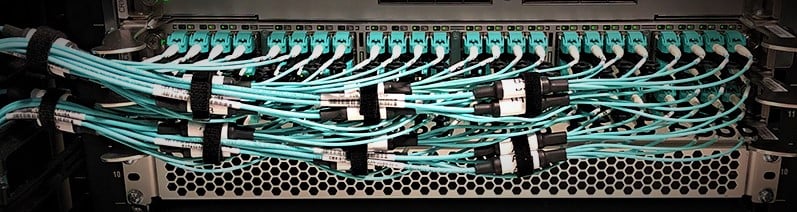
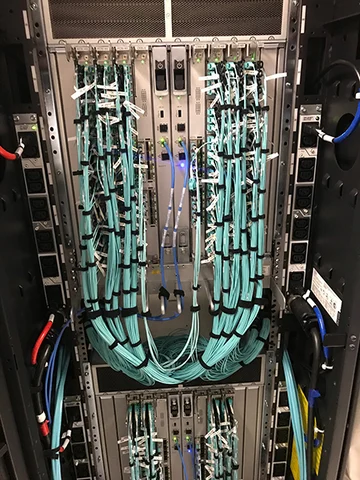
    This brings us to our blog topic of multi-fiber cables in the data center. In plain language, multi-fiber cables are just that: cables with multiple fibers in them. They’re also referred to as fiber optic trunks. In the past, fiber optic “jumpers” or patch cords have been used to connect hardware. The patch cables are essentially single connection points with two fibers inside the outer jacket. That was fine when there were only a few ports, but with the hundreds and thousands of ports data centers now contain, patch cables are an ineffective way to manage your cabling infrastructure. That is where multi-fiber cables come in!

    Benefits of Multi-Fiber Cables in the Data Center

    Since fiber optic cabling is not affected by cross talk or outside interference, the fibers can be condensed into groups that greatly reduce the overall footprint of the cable. This means a lot in a data center, where space is at a premium. It blocks less air from the CRAC (Computer Room Air Conditioner), thus improving the energy efficiency dramatically. Multi-fiber cables also reduce installation and maintenance time by making cable identification easier. Fiber optic trunks, or multi-fiber assemblies, are also more rugged and can withstand more abuse during installation and maintenance.

    To get a better understanding of this product type, have a look at our Skinny-Trunk Multi-fiber assemblies.


  2. Why You Should Respect Layer One in the Data Center

    April 13, 2012 by Josh Taylor

    A while back, we produced some funny videos demonstrating why data center operations should respect their cabling infrastructure and the rest of layer one. I thought it might be a good idea to revisit this series.

    Check out the first video:

    Pretty funny, right? Stay tuned to find out what happens when you don’t respect layer one!


  3. Preparing for the Next-Gen Data Center: 16G Fibre Channel

    February 24, 2012 by Teri Kelly

    Check out our archived webinar, “Preparing for the Next-Gen Data Center: 16G Fibre Channel.” James Mallon, Systems Engineer from Brocade, presented on the changes in the physical layer and hardware platforms when migrating to 16G Fibre Channel.


  4. BISCI Winter Conference Recap: 40/100G Ethernet is Here.

    February 17, 2012 by Josh Taylor

    I just returned from the 2012 BICSI Winter Conference & Exhibition. It was great to get together with other colleagues and individuals that all have one thing in common: we respect layer one! One of the great benefits of this conference is the educational opportunities, and BICSI certainly delivered this year.

    The most common theme that I heard throughout the conference was that 40/100G Ethernet isn’t just on the horizon, it’s already here. This will have profound effects on data center structured cabling – which wasn’t a surprise to me, we’ve been preparing for this for years!

    One of the choices data centers must consider when migrating to 40/100G Ethernet is whether to use fiber or copper cabling. Based on what I’ve seen, fiber will be the primary cabling type. The IEEE 802.3ba standard for 40/100G Ethernet states a maximum distance of 7M to run 40/100G, and that will be using “active” cables. (An active cable is a cable with a transceiver hard-wired to it.) This limitation rules out copper as a primary medium of transport.

    Fiber optic cabling does offer the choice between multi-mode and single-mode cabling. There are a few key factors to weigh here: distance, transmission type and total link cost. Single-mode fiber will run longer distances and will still utilize a serial transmission. Multi-mode fiber will require parallel transmission, which is a dramatic change for many, and can only run limited channel lengths.

    Cost is, of course, key factor here – which makes multi-mode fiber an attractive option. Single-mode fiber is cheaper, but the transceivers are very expensive. Overall, a multi-mode link is projected to be about half the cost of a single-mode. This cost delta is based largely on the expensive lasers required for single-mode transmission. The link distances for multi-mode fiber running 40/100G Ethernet is 100M using OM3 fiber, and 150M using OM4. Since roughly 90% of data center link distances are within the multi-mode distance limitation, it appears to be a no-brainer.

    Because of this, it is evident that multi-mode fiber will be the predominant cabling of choice for these higher network speeds. Single-mode will be used only when necessary, and copper could potentially be utilized in specialized areas where short link distances occur. Another consideration for copper: copper transceivers will utilize more power.

    Choosing your cabling infrastructure is a critical decision for any data center team, but there is a wealth of information out there (and this site!), and I would suggest doing a little research until you feel comfortable with your decision. We also have a dedicated team to help answer any further questions you may have – give us a call and 800.913.9465 to find out more.


  5. Visio Stencils for Data Centers

    January 31, 2012 by Josh Taylor

    I recently wrote about spaghetti cabling in the data center and what you can do about it. One crucial step in this process is to map out your current data center layout (including cabling infrastructure), then use this to create a new map of the ideal data center cabling scenario.

    At CABLExpress, we use Microsoft Visio to accomplish this. The program is ideal for mapping out your current data center layout, as well as creating plans for future upgrades.

    You don’t even have to start from scratch when drawing shapes – Microsoft provides a free download of common data center equipment shapes from manufacturers like 3Com, Cisco, HP and Nortel.

    We also have free Visio stencils of CABLExpress products available for download, such as enclosures, harnesses and racks.