• Get free updates in your inbox. It's quick and easy!
  • Data Center Structured Cabling
  • Categories
  • Archives
  • Latest Posts

  1. End Face Contamination is the Silent Killer of Performance

    March 19, 2013 by Josh Taylor

    Fiber optic cabling provides the massive amounts of bandwidth needed to run today’s bandwidth-hungry data centers. However, end face contamination can virtually cripple the high performance that fiber cabling offers. End face contamination is the silent killer of fiber optic cable assembly performance! The good news is that it is simple to eliminate the problem – so never fear, read on and become educated on the topic.

    • How does the contamination get there?

      The major culprits are skin oils, dust particles and condensation – just to name a few. Even if the assemblies are brand new in the bag, they could still be contaminated with condensation from high elevation transportation and humidity conditions. Watch this short video to learn more.

    • How can you tell if an end face is contaminated?

      Look at it! You can’t see it with the naked eye, but there are many inspection scopes available on the market. The first step is to invest in one. Without being able to get a visual inspection, you are powerless to know if there is a problem or not.

    • How can you get rid of the contamination?

      There are great products on the market to make this VERY easy. One click cleaners are the most common and cost effective at this time. There is a great example in the video mentioned previously.

    So remember to inspect, clean and inspect. Repeat if necessary.

    Oh yeah, don’t forget to Respect Layer One!


  2. A Simple Guide to Fiber Cable Care & Maintenance

    January 8, 2013 by Teri Kelly

    The most basic ways to protect your fiber and maintain maximum performance are to:

    • Minimize end-face contamination
    • Avoid excessive bending

    We have outlined simple ways to approach both of these steps below.

    Minimize End-Face Contamination

    Don’t assume that just because a cable hasn’t been used that there is no risk of contamination. There is always the possibility that condensation has formed during shipping. Contamination (from dust particles, food particles, lint, skin oil, condensation) will increase insertion loss and could lead to downtime.

    Remember to clean end faces prior to mating. Contamination, like the common cold, can be transmitted when mating connectors. Minimize risks by following the “Inspect, Clean, Inspect” routine EVERY TIME and repeat, if necessary!

    For more information on how to inspect and clean your end faces, check out our Cable Talk videos #4 and #23.

    More than 50% of network outages
    are due to end-face contamination!


    Avoid Excessive Bending

    Excessive bending can cause light losses due to micro and macro bends. Bend Insensitive Fiber, commonly called BIF,  is a major improvement and helps to reduce the losses.

    The bend radius is the minimum radius you can safely bend the cable without a loss occurring. The rule of thumb for the bend radius, the typical cable manufacturer standard (with the use of BIF), is that it is 10 times the diameter of the outer jacket of the cable.

    Bend Radius Formula:  Cable Diameter x 10

    • For instance, if you have a 2 mm fiber cable x 10 = 20 mm (bend radius) or 0.79 inches.
    • Now, this bend radius works for how you would typically place your cables in a structured cabling system, but sometimes it’s easier to visualize the diameter. If you’re looking to calculate the bend diameter, simply multiply the bend radius by 2. In this case, the bend diameter is 40 mm or 1.6 inches.

    It may help to envision an everyday object, like a paper towel tube – this is the amount of bend allowed with BIF fiber.

    Prior to BIF, bend losses were much higher. The minimum radius specified was typically not less than 15 times the cable diameter. This means that the fiber cable could only safely bend around the size of a sports drink bottle, almost 2.5 inches!

    Check out Cable Talk video #32 for more info on the bend radius of BIF.

    By following these two simple guidelines – minimizing your end-face contamination and avoiding excessive bending – you will be able to properly maintain your fiber cabling, thus allowing for maximum uptime in your data center.


  3. How High Density Fiber Enclosures Can Make Your Life Easier (Before the World Ends)

    December 20, 2012 by Josh Taylor

    The fiber enclosure, or patch panel, is built and designed for one purpose…to make your life easier! So, before the world ends, you should contemplate all the benefits of implementing high density fiber enclosures in your data center.

    A high density fiber enclosure in the same rack as your high density switch will make a world of difference.

    With the enclosure in place, you no longer have to run long jumpers across the room, under the floor or in overhead conveyance. Instead, you simply run a short fiber patch cable from your SAN or network switch up to the fiber enclosure. It’s really that simple!

    Now, let’s focus on the high density aspect. Since conditioned space is very expensive, rack space has quickly become the most valuable part of a data center. High density in an enclosure can help you save this precious rack space.

    With the above things considered, do yourself a favor before the world ends (ha!) and think about implementing high density fiber enclosures in your data center. It will save you lots of grief and you will see firsthand how these enclosures will truly make your life much easier!


  4. Short On Data Center Space? Things are Looking Up!

    December 7, 2012 by Rick P

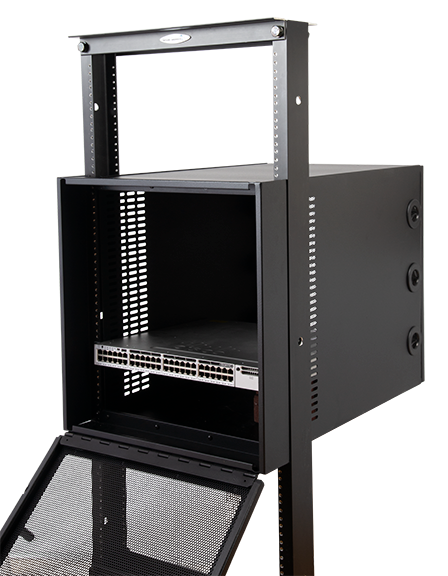
    Short on Data Center Space? Ladder Rack Enclosure from CABLExpressThis post is just a quick reminder that there are some cool items and solutions out there that will really help you save space in the data center.

    Are you short on space and looking for room?  Look up!  

    There is useful space up there. Well, there could be.   When you are short on space, one of the options you have is going above the rack.  For instance, this ladder rack enclosure gives you an effective, organized way to make the space above the rack useful.

    What exactly is the ladder rack enclosure?

    It’s an enclosure that mounts above a rack or cabinet. It can be affixed to either ladder rack and/or basket tray. This is a good option for those that use overhead conveyance. Much like zero U brackets, it does not use rack space and allows for a TIA-942 recommended structured cabling system.


    Sure, there are plenty of ways to utilize space in the data center.  Here’s another.  It’s always good to have options and tools in the toolbox.

    We hope you keep this in mind if your data center journeys bring you to a place where you are short on space or you need to use space wisely and creatively.


  5. A Super Simple Way To Reduce Your Data Center Cable By Up To 33%

    November 29, 2012 by Rick P

    Do you want to reduce your cable center cable by up to 33% and save space in the data center?

    Of course, you do.  Everyone who has a well-organized, efficient data center does.

    There are some well known facts about the data center.

    • People want to reduce clutter and optimize usage of space
    • People want to control data center cooling
    • People want to have a manageable cabling infrastructure
    • People want to get more with less

    With that in mind, if someone can reduce data center cable by 33% they will do what is necessary to achieve this.  Well, here’s  a really simple way to help you do this.

    CABLExpress® Announces Significant Reduction in Skinny-Trunk® Fiber Optic Patch Cord Size

    CABLEXPRESS SKINNY-TRUNK(R) CORD

    CABLExpress has enhanced its Skinny-Trunk® fiber optic patch cord in its Uniboot product line by reducing both the diameter and bend radius by more than 33 percent, changing it from 3 mm to 2 mm. This enhancement will allow for substantial data center infrastructure cabling reduction without altering the existing technology. (to find out more click here)

    Okay I kind of cheated. You were expecting an article about some new concept / design / technique / strategy, right? Fortunately, sometimes the answers are easy.   That’s a good thing.  We are continually working on increasing the performance of your data center cabling and making your lives easier.
    As always, if you want to know more about this product or how you can improve your cabling infrastructure please give us a a call or contact us.